Portable Power: Choosing the Right Power Bank for Your Devices
Choose the right power bank for phones, tablets, and laptops with tips on capacity (mAh), wattage (PD), ports, safety features, and airline rules.
Know Your Power Needs
Choosing the right power bank begins with understanding your power profile: which devices you carry, how intensively you use them, and how long you're away from outlets. Phones, tablets, earbuds, e-readers, handheld consoles, and even ultraportable laptops all demand different voltages, currents, and capacities. Look at your device's battery size and charging adapter to gauge requirements; phone batteries are often labeled in mAh, while many larger devices reference wattage and sometimes watt-hours (Wh). As a rule of thumb, a power bank's advertised mAh doesn't equal the number of phone recharges due to conversion losses, cable resistance, and standby drain. If you commute and stream constantly, you'll likely want higher capacity; if you mainly top up at midday, a slim bank might suffice. Gamers, photographers, and navigation-heavy travelers should budget extra. Laptops and certain tablets benefit from USB-C and Power Delivery (PD) support to negotiate higher voltages. Begin with your daily scenarios—meetings, flights, outdoor activities—then select a bank that comfortably covers peak days with a buffer.
Capacity, Efficiency, and Real-World Runtime
Advertised capacity can be misleading without considering efficiency. Power banks list mAh based on internal cell voltage (commonly around 3.6–3.7 V), but your devices usually charge at 5 V or higher. Converting from the cell voltage to output voltage consumes energy, and thermal losses further reduce deliverable power. A practical way to compare models is by Wh (watt-hours): multiply mAh by nominal cell voltage and divide by 1,000. Then expect only a portion of that to reach your device due to conversion losses. For example, a power bank rated at 10,000 mAh roughly equates to about 37 Wh internally; depending on design, cables, and conditions, the usable output may be noticeably lower. Charging at higher voltages (e.g., PD at 9 V or 12 V) can be more efficient in some cases but also depends on regulation quality and load. Cold or hot environments, thin or overly long cables, and simultaneous multi-device charging all influence outcomes. When in doubt, plan for a margin above your calculated need.
Charging Speeds and Standards
Speed matters, but it must match your device's charging standard. Modern banks offer USB Power Delivery (PD) for flexible voltage and current negotiation, and some support PPS (Programmable Power Supply) for fine-grained control favored by many newer phones. You may also encounter proprietary fast-charge technologies; if your device supports them, ensure the bank lists compatible profiles. Read output labels carefully: entries like 5 V/3 A, 9 V/2 A, or 12 V/1.5 A translate to wattage by multiplying volts by amps. For laptops and larger tablets, check the wattage your adapter provides and choose a bank that meets or exceeds it on at least one USB-C port. Multi-port models often share a total power budget; plugging in a second device can reduce speed if the bank reallocates current. Good designs articulate per-port and combined maximums, while entry-level models may fall back to standard 5 V charging under load. Pair the bank with an appropriate cable; some high-wattage scenarios require e-marked USB-C cables for safe delivery.
Ports, Cables, and Versatility
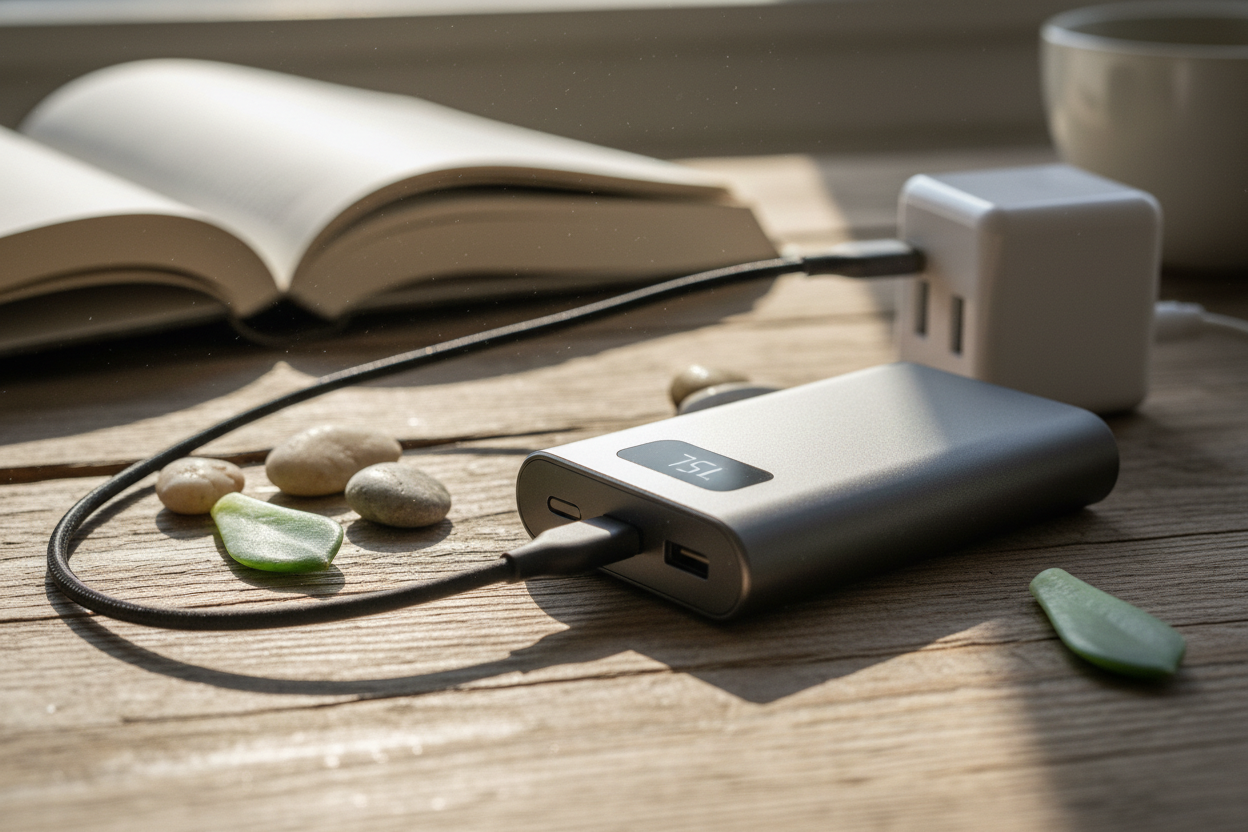
Port selection dictates flexibility. A bank with USB-C input/output and additional USB-A ports covers most scenarios, while legacy micro-USB inputs can slow refills and limit convenience. Dual-role USB-C ports that both charge the bank and your devices simplify packing. Consider whether the unit supports pass-through charging (powering devices while the bank itself is charging), though this can generate heat and sometimes reduces overall efficiency. Cable choice also matters: thicker, well-shielded, and correctly rated USB-C cables maintain higher currents with less voltage drop, improving performance. Some banks integrate short cables for convenience, while others include hidden compartments or connectors to reduce clutter. Wireless options add Qi charging or magnetic alignment for phones and earbuds, but expect lower efficiency and slower speeds compared to wired connections, especially when the bank warms up. Additional features—like a digital percentage display, multiple output profiles, trickle-charge mode for wearables, or a low-profile form factor that tucks behind a phone—can elevate everyday usability.
Safety, Durability, and Battery Health
Quality power banks emphasize safety. Look for robust battery management systems (BMS) featuring overcurrent, overvoltage, short-circuit, and thermal protections. Reputable models often cite independent certifications and use flame-retardant housings with thoughtful venting and heat dissipation. Internally, most banks use lithium-ion or lithium-polymer cells; cell binning, balancing, and protective circuitry influence longevity as much as raw capacity. Handle them like the batteries they are: avoid leaving a bank in hot cars, don't crush or puncture it, and keep it dry. For battery health, partial charge cycles are gentler than constant deep discharges; storing around a mid-level state of charge helps reduce stress during long idle periods. Charging the bank with a moderate-wattage adapter can limit heat and extend lifespan. For travel, pack power banks in carry-on luggage and check airline guidelines regarding capacity limits measured in Wh. A durable exterior, reinforced ports, and solid internal construction often outlast bargain options that cut corners on safety and materials.
Size, Design, and Value
The best choice balances capacity, size, weight, and price. Pocket-friendly banks trade runtime for portability, ideal for light users and short outings. Larger models deliver more Wh and higher wattage output for tablets and laptops, but they add bulk to your bag. Build quality matters: textured shells resist slips, curved edges improve grip, and clear readouts beat vague blinking LEDs. A well-designed interface—with distinct port labels, an accurate display, and a responsive power button—saves guesswork. Consider real-world convenience features such as fast recharging of the bank itself, pass-through support, trickle-charge mode, and a bright yet efficient indicator. Solar add-ons can help in emergencies but rarely replace wall charging due to limited panel size; treat them as supplementary. Finally, weigh warranty, customer support, and serviceability. A slightly pricier, well-supported model often delivers better long-term value than a bargain bank that degrades quickly. Choose thoughtfully, and your portable power will feel seamless rather than scarce.